Thermogravimetric Analysis (TGA) of Coatings
What TGA reveals about coating mass loss, volatiles, decomposition and residue, and why atmosphere, sampling and test conditions determine the interpretation.
Key takeaways
- TGA follows specimen mass during a controlled temperature and atmosphere program.
- Mass-loss steps support compositional comparisons but do not identify every ingredient.
- Atmosphere, specimen preparation and heating conditions must accompany the result.
- A decomposition temperature alone does not establish a coating’s service-temperature limit.
What does TGA measure?
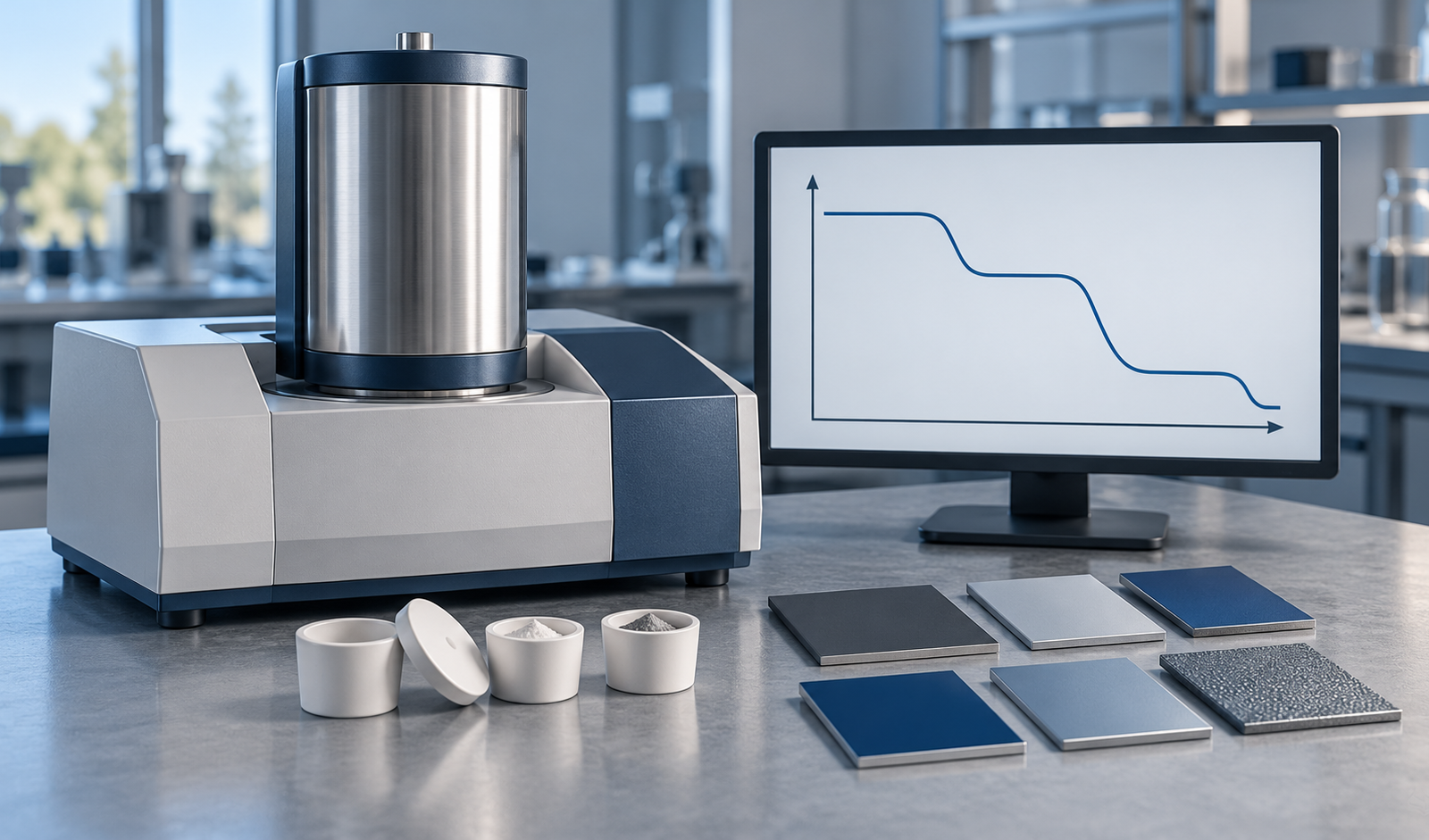
Thermogravimetric analysis (TGA), also called thermogravimetry or TG, measures changes in a specimen’s mass as temperature or time changes under defined conditions. A sensitive balance tracks the material while an instrument controls its thermal environment. Mass can decrease through evaporation or decomposition, or increase during reactions such as oxidation. TA Instruments’ TGA overview describes the measurement and its analytical uses.
For coatings, TGA helps investigate volatile material, decomposition behavior and the residue remaining after a specified program. It can compare a suspect film with an appropriate reference or support formulation quality control. The useful question is usually specific: what changed between these samples, under these test conditions?
Reading the mass and derivative curves
The main trace commonly shows remaining mass as a percentage of the starting specimen mass. A step indicates a net mass change over a temperature or time interval. Its size depends on how the starting mass and interval boundaries are defined.
A derivative trace, usually called DTG, displays the rate of mass change. Peaks or minima help locate rapid changes and distinguish partly overlapping events; the displayed sign and units depend on the plotting convention. A derivative peak marks a rate maximum, not an ingredient’s identity. TA Instruments’ discussion of mass-loss resolution illustrates how derivative signals help separate events.
Why the atmosphere matters
A program under nitrogen or another suitable inert gas examines a different reaction environment from a program in air. A laboratory may use both, with an explicitly recorded changeover, to distinguish contributions that respond differently to oxidation. ISO 11358-1:2022 describes general thermogravimetric analysis of polymers, including programmed-temperature and isothermal measurements under different atmospheres.
Results therefore need the gas identity, flow conditions and switching sequence. “Residue at the final temperature” is incomplete without that context. Material left after inert heating can include carbonaceous products that would change during a subsequent oxidative stage. A polymer-characterization study in Green Chemistry used subsequent air analysis to investigate such char residues. Even when total loss looks similar, different programs may represent different chemistry.
How far can composition be inferred?
ASTM E1131-25 provides a general compositional-analysis framework for volatile fractions, combustible material and ash, using inert and reactive environments. Its public scope covers solids and liquids. These categories are useful for comparing materials, but they are not a complete formulation recipe.
Do not automatically label every early loss “water,” every later loss “binder,” or the final residue “original pigment content.” Constituents can overlap, char can form, and inorganic ingredients can themselves lose mass. Calcium carbonate, for example, releases carbon dioxide as it decomposes; NETZSCH’s TGA–FTIR application note demonstrates this reaction. A residue-based estimate requires knowledge of the relevant reactions and mass balance.
When assigning a particular loss matters, evolved-gas analysis can add chemical evidence. Coupling TGA with infrared spectroscopy or mass spectrometry examines released gases, while analysis of the original film or remaining solids answers other questions. NETZSCH’s coatings overview describes the value of combining thermogravimetry with evolved-gas analysis.
Prepare a meaningful comparison
Define whether the specimen represents a free film, one layer, a multilayer fragment or material containing substrate. A whole-system fragment answers a different question from an isolated topcoat. Record collection location, coating identity, cure history, exposure and storage conditions. These are practical sampling recommendations, rather than a substitute for the selected laboratory method.
Agree whether the purpose is to examine material as received or after conditioning. Drying a specimen before investigating retained volatiles changes the evidence being examined. Preserve an appropriate comparison sample and disclose preparation that might alter composition.
Specimen size and shape, heating rate, gas flow and crucible configuration influence the measured response. A matched comparison should control them rather than merely use the same final temperature. NETZSCH’s test-variable study demonstrates several of these effects; TA Instruments’ resolution note also identifies heating rate and sample size as important variables.
For complementary methods, see differential scanning calorimetry and the broader discussion of testing coating cure.
What TGA does not establish
A reported onset or specified-percentage-loss temperature describes a chosen analysis convention and experiment. It cannot, by itself, authorize continuous service at a lower temperature. A coating can soften or lose another required property without a corresponding large mass change. Service suitability needs relevant exposure and performance evidence.
Similarly, one trace does not establish a field lifetime. Kinetic interpretation is a separate undertaking with assumptions and applicability limits; the public scope of ASTM E1641-23 makes those restrictions explicit. TGA alone also does not measure substrate adhesion or certify complete cure.
What belongs in the report?
- Specimen identity, sampled layer, preparation, conditioning and initial mass
- Instrument, crucible and relevant calibration or verification information
- Complete temperature/time program and atmosphere sequence
- Mass and DTG curves, units, normalization basis and evaluation boundaries
- Definition of each reported onset, peak, loss fraction and residue
- Reference samples, repeat measurements, uncertainty and limits on chemical assignments
Use the applicable complete method when testing to a standard. This overview describes interpretation and reporting considerations; it does not reproduce a standardized operating procedure.
Educational reference. Coating performance varies by formulation. Always follow the manufacturer’s product data sheet, safety data sheet and your project specification.