Edge & Weld Preparation
Sharp edges, weld spatter, undercut and porosity are where coatings fail first. Edge and weld preparation removes these defects so the coating can build full thickness everywhere.
Key takeaways
- Coatings pull away from sharp edges and pool unevenly over rough welds, leaving thin spots, pinholes and voids where corrosion starts first.
- ISO 8501-3 defines three preparation grades, P1 (light), P2 (thorough) and P3 (very thorough), for edges, welds and other surface imperfections.
- Tank and vessel linings commonly follow NACE SP0178, which defines weld finish designations from fully ground flush to essentially as-welded.
- Grinding and dressing are done before abrasive blasting so the repaired areas receive the same cleanliness and profile as the rest of the steel.
Inspect almost any aging steel structure and the pattern is the same: rust lines trace the flange tips, plate edges, bolt holes and weld seams long before the flat surfaces show distress (see edge corrosion). Edge and weld preparation is the fabrication and surface-prep work that removes the geometric and metallurgical defects responsible. It is cheap during fabrication and expensive to correct after coating.
Why edges and welds fail first
Liquid coatings are pulled by surface tension toward a shape with the least surface area. Over a sharp 90° edge, the wet film draws back from the corner as it cures, leaving a coat that may be only a small fraction of the thickness on the adjacent flat surface. Thin films are more permeable and more easily damaged by impact.
Welds add other problems:
- Weld spatter forms sharp, poorly bonded globules that poke through the film and can break off later, leaving bare spots.
- Undercut at the weld toe creates a notch that traps air and is hard to blast and coat fully.
- Porosity leaves pinholes that trap air and solvent, causing holidays and pinholes in the coating.
- Slag and flux residues are alkaline and poorly bonded; coating over them invites blistering and disbondment.
- Rough weld profiles with sharp ripples or overlaps create shadows that abrasive and spray cannot reach evenly.
Crevices such as skip-welded joints and back-to-back angles also trap moisture that coatings cannot bridge, promoting crevice corrosion.
ISO 8501-3 preparation grades
ISO 8501-3 describes preparation grades for welds, edges and other areas with imperfections on steel to be painted. It is used alongside the cleanliness grades of ISO 8501-1. In broad terms:
| Imperfection | P1 – light | P2 – thorough | P3 – very thorough |
|---|---|---|---|
| Sharp edges | No preparation | Edges rounded | Edges rounded to a radius of at least 2 mm |
| Weld spatter | Loose spatter removed | Loose and lightly adhering spatter removed | All spatter removed |
| Weld profile and ripples | No preparation | Irregular, sharp profiles smoothed | Welds fully dressed to a smooth profile |
| Undercut and porosity | Generally no preparation | Sharp or open defects repaired or ground | Free of undercut and surface pores |
| Thermally cut edges | No preparation | Irregular profile removed | Cut surface removed and edge rounded |
This table summarizes the intent only; the standard itself lists each imperfection type and its required treatment. ISO 12944 links the choice of grade to service life and corrosivity, and P2 or P3 is commonly specified for higher corrosivity categories and immersion (see ISO 12944 corrosivity categories).
Weld preparation for tank linings
For steel tanks and vessels that will be lined for immersion, NACE SP0178 covers design and fabrication details and defines weld finish designations. They range from welds ground smooth and flush with all defects removed, through intermediate levels of grinding, to welds left essentially as welded with only spatter removed. The specification chooses the designation based on the lining and the service. High-build, rigid or thin-film linings in aggressive chemical service generally need the more thorough levels (see storage tank linings).
Many coating problems on edges begin in the fabrication shop. Specifying the edge and weld grade in the fabrication contract, not only in the painting specification, is the most reliable way to get it done before steel is delivered.
How to prepare edges and welds
- Identify defects. Inspect after fabrication and before blasting. Mark sharp edges, spatter, undercut, porosity, laminations and slag.
- Remove spatter and slag. Chip, scrape or grind spatter to the required grade; remove all slag and flux residue.
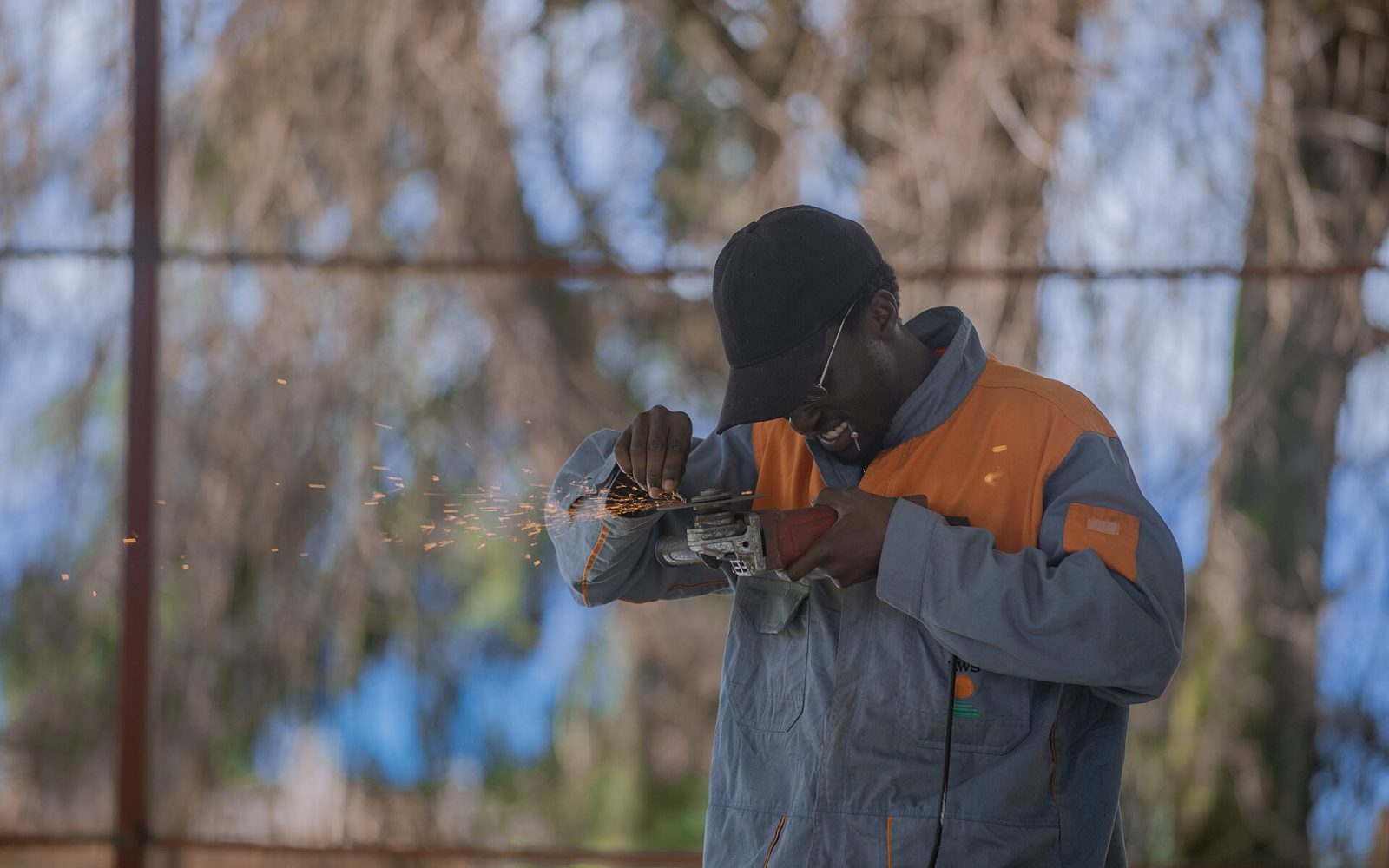
- Round edges. Grind or file sharp and flame-cut edges to the specified radius. Chamfering with a single 45° pass leaves two new sharp corners; a true radius gives better coating retention.
- Dress welds. Smooth sharp ripples and overlaps, and repair undercut and porosity by welding and regrinding where required.
- Seal crevices. Seal-weld or, where approved, caulk skip welds, lap joints and back-to-back members.
- Blast. Abrasive blast to the specified cleanliness and profile; grinding leaves a smooth, polished surface that needs blasting to restore anchor pattern.
- Stripe coat. Brush or spray an extra coat on edges, welds and corners before or between full coats (see stripe coating).
Thermally cut edges, particularly from oxy-fuel and plasma cutting, can develop a hardened surface layer that resists abrasive blasting and produces a shallow profile. Grind the cut face back to sound steel where the specification requires it, then confirm profile on the edge as well as the flat.
Inspection and acceptance
Edge and weld preparation is a hold point on many projects, inspected before blasting and again after. Typical checks include:
- Visual comparison with the ISO 8501-3 grade or NACE weld designation specified.
- Checking edge radius with a radius gauge where a minimum is specified.
- Running a gloved hand or clean cloth along edges to find spatter and burrs that catch.
- Confirming profile on ground areas after blasting.
- After coating, holiday testing of welds and edges in lining work.
Frequently asked questions
What edge radius should I specify?
ISO 8501-3 grade P3 requires a radius of at least 2 mm. Some lining specifications set their own minimum, often around 1/8 in (3 mm). Use what the specification and coating manufacturer require.
Can’t I just stripe coat instead of grinding edges?
Stripe coating helps but does not replace preparation. On a sharp edge, the stripe coat also pulls back. Rounding the edge first lets both the stripe and full coats build proper thickness.
Does edge preparation matter for galvanized or powder-coated parts?
Yes. Sharp edges and spatter cause thin spots in powder coatings and can affect hot-dip galvanizing and duplex systems. Fabricators commonly deburr and remove spatter for all coating types.
When should weld defects be fixed?
Before abrasive blasting, ideally in the fabrication shop. Grinding after blasting removes profile and leaves contaminated, polished steel that must be re-blasted.
Educational reference. Coating performance varies by formulation. Always follow the manufacturer’s product data sheet, safety data sheet and your project specification.