Spray Polyurethane Foam Roofing
How spray polyurethane foam (SPF) roofs are built, why the elastomeric coating on top is essential, and what governs a durable, watertight installation.
Key takeaways
- An SPF roof is a layer of closed-cell polyurethane foam sprayed onto the roof deck, which then cures into a seamless, fully adhered, insulating membrane.
- The foam must be protected from sunlight by an elastomeric coating or aggregate. Without it, UV degrades the foam surface within months.
- Weather governs quality: the substrate must be dry, and wind, temperature and dew point all affect the foam and the coating.
- The texture of the foam surface is graded from smooth to treebark, and rough textures must be corrected before coating.
- With regular inspection and periodic recoating, an SPF roof can be renewed rather than torn off.
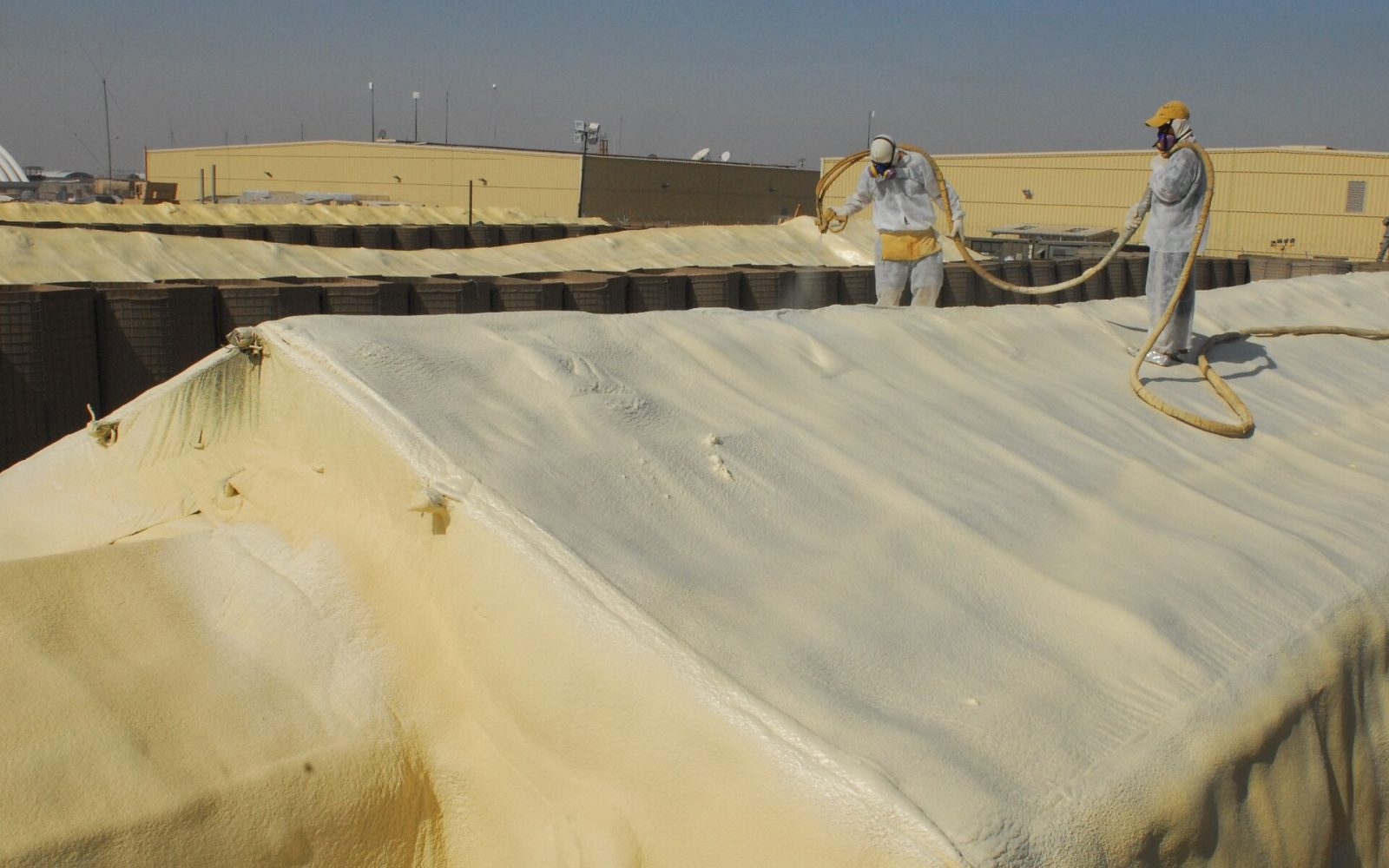
Spray polyurethane foam (SPF) roofing is a roofing system made by spraying a two-component liquid that expands into rigid, closed-cell foam directly on the roof. It is used on low-slope commercial, industrial and institutional roofs, on new decks and as a recover over many existing roofs. The finished system has two parts: the foam, which provides insulation, slope and the waterproof body, and a protective coating, which shields the foam from UV, weather and wear.
How SPF roofing works
The A side is a polymeric MDI isocyanate. The B side is a polyol blend containing blowing agents, catalysts, surfactants and fire retardants. A heated plural-component proportioner meters the two sides in a fixed ratio, typically 1:1 by volume, and mixes them at the spray gun. The mix reacts and expands within seconds, forming a rigid foam with a high proportion of closed cells. The underlying reaction is covered in isocyanate chemistry.
Roofing-grade foam is denser than wall insulation, commonly around 2.5–3 lb/ft³ (40–48 kg/m³), which gives it the compressive strength to carry foot traffic and the water resistance to act as the roof body. Installed foam often provides around R-6 per inch, depending on the formulation and blowing agent. Because it bonds to the deck and flows around penetrations, it is seamless and self-flashing, and applicators can vary its thickness to build slope toward drains.
Advantages
- Seamless and fully adhered, with no laps or fasteners
- Adds continuous insulation and can be tapered to remove ponding
- Lightweight; often installed over an existing roof where codes allow
- Renewable by cleaning and recoating
Limitations
- Highly weather-sensitive during installation
- Overspray can drift onto vehicles and buildings
- Foam is vulnerable to UV, foot traffic damage, hail and birds if the coating is neglected
- Needs trained crews, specialized equipment and isocyanate controls
Protective coatings
Uncoated foam darkens and becomes friable on the surface as UV breaks it down. The coating is therefore an essential part of the system, not an optional finish. It also adds weather and impact resistance and contributes to fire classification. Most are elastomeric coatings; see also roof coatings.
| Coating type | Strengths | Watch-outs |
|---|---|---|
| Acrylic (waterborne) | Economical, reflective, easy to apply | Not for ponding water; vulnerable to rain, dew and cold during cure |
| Silicone | Excellent UV and ponding-water resistance, high solids | Picks up dirt; generally only silicone adheres to it when recoating |
| Polyurethane (aromatic base, aliphatic top) | Tough, abrasion and foot-traffic resistant | Solvent and isocyanate content; more involved application |
| Polyurea and hybrids | Fast cure, very tough, impact resistant | Aromatic grades need a UV-stable topcoat; specialist equipment |
Coating thickness is specified as a minimum dry film. Total dry films in the range of roughly 20–30 mils (500–750 µm) are common, but the system manufacturer’s specification and any warranty requirement govern. Granules broadcast into the wet coat improve walkway durability and impact resistance.
Substrate preparation and weather limits
SPF bonds to metal, concrete, wood with suitable cover boards, and many existing roof membranes, but only if the surface is clean, dry, sound and compatible. Typical preparation includes:
- Moisture surveys of existing roofs, using infrared, capacitance or nuclear methods, and core cuts to find and remove wet insulation. Never foam over trapped moisture.
- Removing loose gravel, dirt, oil and chalky or failing coatings; securing loose flashings and fasteners.
- Priming metal, concrete or some membranes where the manufacturer requires it.
During spraying, the substrate must be dry and above the minimum temperature on the data sheet, and the surface should be above the dew point. Wind is the most common limit: it carries overspray, cools the foam and distorts its cell structure. Crews often use windscreens and stop when gusts exceed safe limits. See environmental conditions for coating.
Installation sequence
- Prepare and protect. Clean the roof, mask rooftop units and intakes, and set overspray controls and exclusion zones.
- Spray foam in passes. Build the foam in lifts, commonly at least ½ in (13 mm) each, as the manufacturer directs, until the specified thickness and slope are reached.
- Check thickness and texture. Probe the foam depth and assess surface texture; correct rough areas.
- Coat promptly. Apply the base coat the same day or within the manufacturer’s maximum UV-exposure window.
- Topcoat and granules. Apply the remaining coats to the specified dry film, adding granules in walkways.
- Inspect. Verify coating thickness and look for pinholes, blisters, voids and missed areas.
Foam surface texture
The texture of the cured foam surface shows how well it was sprayed and how much coating it will need. Industry guidance grades it roughly as follows:
| Texture | Description | Suitability for coating |
|---|---|---|
| Smooth | Spray pattern visible; very even | Ideal |
| Orange peel | Fine, regular dimpling | Ideal |
| Coarse orange peel | Larger nodules, still compact | Acceptable |
| Verge of popcorn | Rounded nodules, small valleys | Marginal; needs extra coating or correction |
| Popcorn or treebark | Deep voids, nodules or ridges | Unacceptable; remove and re-spray |
Rough textures increase surface area, so they need more coating to achieve continuous protection, and their deep valleys are hard to seal. Wind and incorrect gun distance or technique are the usual causes.
Measure coating thickness with a wet-film gauge as you apply it and calculate the dry film from the volume solids. On rough foam, also check by cutting small samples where the specification allows; see wet film thickness measurement.
Maintenance and safety
Inspect SPF roofs at least once or twice a year and after severe weather. Look for punctures, bird pecking, hail damage, blisters, worn walkways and areas where the coating has thinned. Small repairs use compatible sealants and coating. When the coating weathers thin, the roof is cleaned, any wet foam is replaced and a new coating is applied, which renews the system without a tear-off.
Spraying foam releases MDI aerosol and vapor, which can sensitize the lungs and skin. Applicators need supplied-air or other suitable respiratory protection, skin and eye protection, and controlled zones. Building intakes must be shut off or protected, and occupants kept out of affected areas. Follow the SDS, the manufacturer’s guidance and your isocyanate safety program. Fresh foam is combustible, so control hot work near the roof.
Frequently asked questions
How long does an SPF roof last?
The foam itself can last for decades if the coating is maintained. Coatings are commonly renewed every 10–20 years, depending on type, thickness, climate and traffic.
Can SPF be installed over an existing roof?
Often, yes, provided the existing roof is dry, sound and compatible and local codes permit a recover. Wet insulation must be found and removed first.
Why must the foam be coated so quickly?
UV starts degrading the foam surface almost immediately. Manufacturers set a maximum exposure time before the base coat, often measured in hours to a few days.
Is SPF the same as spray foam wall insulation?
They share the same chemistry, but roofing foam is formulated at higher density and compressive strength and must always be protected by a coating or covering.
Educational reference. Coating performance varies by formulation. Always follow the manufacturer’s product data sheet, safety data sheet and your project specification.