Concrete Crack Repair Before Coating
Concrete cracks must be assessed and treated before coating so they do not reflect through the finished system. Repair depends on whether the crack is moving or dormant, wet or dry, and structural or cosmetic.
Concrete crack repair before coating is the preparation step in which cracks, joints and surface defects in concrete are assessed and treated so that the applied coating can perform. Cracks that are ignored usually reflect through thin coatings, let moisture and contaminants under the film, and become the starting point for delamination. The right repair depends on why the crack formed and whether it is still moving.
Types of cracks
Shrinkage cracks
Plastic and drying shrinkage cracks form as concrete loses water. They are usually fine, random or map-patterned, and often dormant once the slab has dried and stabilized.
Settlement and structural cracks
Cracks caused by settlement, overloading or structural movement may be wider, offset across the crack, or growing. These require evaluation by an engineer before any coating work.
Thermal and moving cracks
Cracks that open and close with temperature or loading are “working” cracks. They behave like joints and need a flexible treatment.
Control and construction joints
Joints are designed cracks. Saw-cut control joints and construction joints must be honored in the coating system or treated with joint filler according to the design and the coating manufacturer.
Assessing cracks
Before choosing a repair, determine:
- Width, measured with a crack comparator card.
- Activity: whether the crack is moving. Crack monitors or simple tell-tale gauges can be used over time.
- Moisture: whether water is seeping through.
- Cause: shrinkage, settlement, corrosion of reinforcement, or overload.
- Depth: surface-only or full depth.
Cracks caused by corroding reinforcement need concrete repair, not just filling.
Repair methods
Routing and filling
A common approach for dormant cracks is to rout or chase the crack with a crack-chasing diamond blade or grinder to open it into a clean V or U shape, vacuum it out, and fill with a rigid filler such as epoxy paste, epoxy mortar or a fast-setting polymer. The filled crack is ground flush before coating.
Gravity feed and injection
Fine cracks can be filled with low-viscosity epoxy by gravity feed or pressure injection. Structural epoxy injection is used to bond the two sides of a crack back together and should be specified by an engineer.
Flexible fillers for moving cracks
Moving cracks need a flexible material such as a semi-rigid polyurea joint filler or a polyurethane sealant. Some coating systems also use a detail coat or fabric reinforcement over the crack to spread the movement across a wider band (see stripe coating).
Joint fillers
Semi-rigid fillers support wheel loads at joint edges in industrial floors, while still allowing small movement. Polyurea joint fillers are popular because of their fast cure. ArmorThane, for example, publishes guidance on concrete joint filler selection. The joint filling plan should be agreed before coating, because some systems coat over joints and others stop at them.
Wet and leaking cracks
Active leaks may need hydrophilic or hydrophobic polyurethane injection resins that react with water. These are a specialized waterproofing repair and are usually done before any surface coating.
Surface defects that go with cracks
Crack repair is often combined with repair of:
- Spalls and popouts, patched with repair mortar or epoxy mortar.
- Bug holes and voids on vertical surfaces, filled with a cementitious coating or epoxy surfacer to reduce pinholes and outgassing.
- Scaled or weak surfaces, removed and resurfaced.
Sequence on a typical floor project
- Survey and map cracks and joints.
- Mechanically prepare the floor to the specified profile (see concrete surface profile (CSP)).
- Rout and clean cracks.
- Fill cracks and repair spalls with compatible materials.
- Allow repairs to cure as instructed, then grind flush.
- Vacuum thoroughly.
- Prime, detail and apply the coating system.
Coating systems and crack bridging
Rigid coatings such as standard epoxies will crack again if the crack moves. Elastomeric systems such as polyurea coatings and elastomeric coatings can bridge some movement, depending on thickness and formulation. Any crack-bridging claim should come from the manufacturer’s test data, not assumption.
Common mistakes
- Coating over open cracks without treatment.
- Filling moving cracks with rigid filler.
- Failing to clean dust from routed cracks, so the filler does not bond.
- Overfilling and not grinding repairs flush, which telegraphs through thin coatings (see telegraphing).
- Coating over active leaks.
Key terms
- Static crack. A crack that no longer moves, such as a plastic shrinkage crack in old concrete.
- Active (moving) crack. A crack that opens and closes with temperature, load or settlement.
- Control joint. A planned groove that encourages cracking at a chosen line.
- Expansion joint. A full-depth separation that accommodates movement and must be honored through the coating.
- Semi-rigid filler. A joint or crack filler, often polyurea or epoxy, that supports wheel edges while allowing slight movement.
- Routing. Widening a crack to a uniform groove so filler can bond to sound walls.
Frequently asked questions
Will a coating hide hairline cracks?
Thick, flexible coatings may bridge hairline cracks. Thin coatings usually show them. Treat cracks first if appearance or watertightness matters.
Do I need to repair cracks in a garage floor before coating?
Generally yes. Routing and filling is standard practice in garage floor coatings.
Can I coat over control joints?
Only if the system is designed for it. Most systems honor control joints or fill them with a semi-rigid filler first.
Related entries
- Concrete surface preparation
- Concrete floor coatings
- Floor coating failures
- Coating concrete
- Concrete surface profile (CSP) (new)
- Telegraphing (new)
Educational reference. Coating performance varies by formulation. Always follow the manufacturer’s product data sheet, safety data sheet and your project specification.
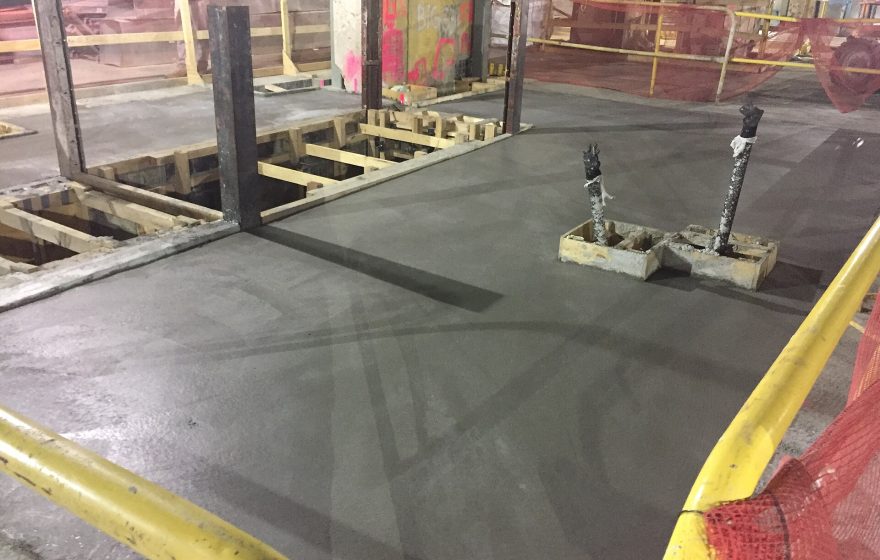

[…] Cracks and control joints in a concrete slab often reappear as lines in floor coatings, especially thin films and self-leveling systems. If the crack is active, it can also crack the coating (see concrete crack repair before coating). […]