Broadcast Flooring Systems
How sand, quartz, flake and other aggregates are seeded into wet resin to build texture, thickness and decorative finishes on industrial and commercial floors.
Key takeaways
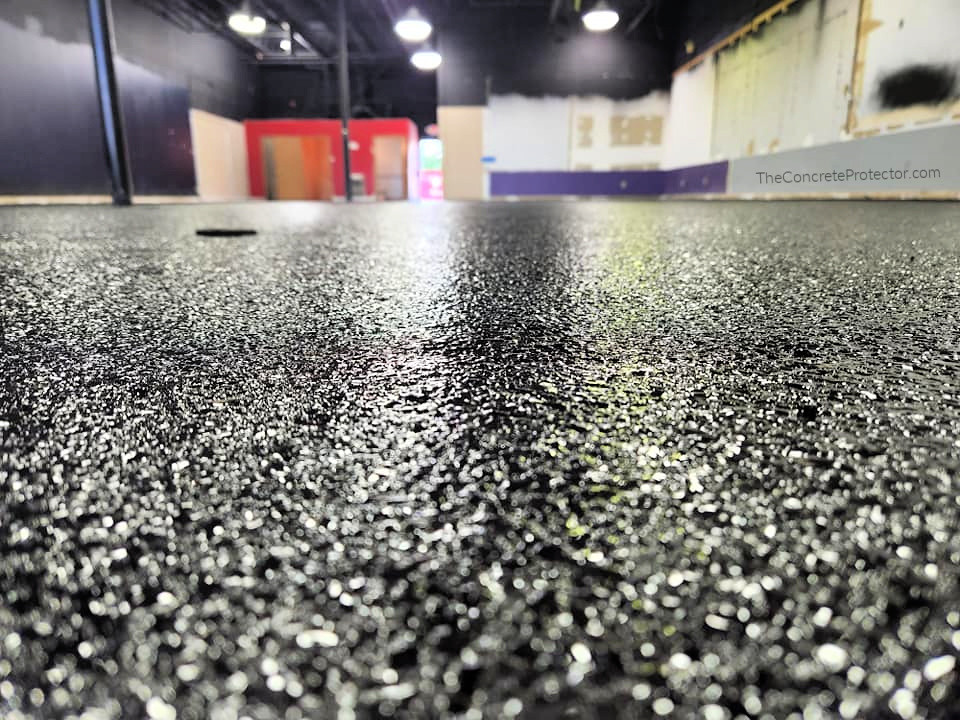
- A broadcast floor is built by applying a resin body coat and throwing dry aggregate into it while it is still wet.
- Broadcasting “to refusal” — until the wet resin cannot absorb any more — gives the most uniform, highest-build result.
- Aggregate type and particle size control texture, slip resistance, appearance and how much resin the topcoat needs.
- Excess loose aggregate must be scraped and vacuumed before sealing, or it will be locked into the finish as defects.
Broadcast flooring systems are among the most common resinous floors in plants, warehouses, commercial kitchens, garages and public spaces. Rather than placing one thick layer, the installer builds the floor from alternating layers of liquid resin and dry aggregate. The aggregate adds bulk and texture at low cost, reinforces the resin and — when it is decorative quartz or vinyl flake — produces a finished appearance that hides dirt and minor substrate imperfections.
The resin is usually an epoxy, though polyaspartic, polyurethane, MMA and urethane cement binders are also used depending on cure speed, temperature and chemical exposure.
How a broadcast system is built
A typical system has four layers: a primer that penetrates and seals the prepared concrete, a body coat that receives the broadcast, the aggregate itself, and one or more seal or grout coats that lock the aggregate in place and set the final texture. Repeating the body coat and broadcast steps — a double broadcast — builds a thicker, tougher floor.
- Prepare and prime. Prepare the slab mechanically to the profile the system requires (see concrete surface preparation) and apply the primer.
- Apply the body coat. Spread resin with a notched squeegee and back-roll to an even film at the specified spread rate.
- Broadcast the aggregate. While the resin is still wet, throw aggregate up and let it fall onto the surface in an even shower, working until the wet resin is fully covered.
- Cure, scrape and vacuum. Once cured enough to walk on, scrape off loose and high particles and vacuum thoroughly.
- Repeat if specified. For a double broadcast, apply a second body coat and broadcast again.
- Grout and seal. Apply the grout or seal coat with a flat squeegee and back-roll. Add a topcoat if the system calls for one.
Aggregate types and uses
| Aggregate | Typical use | Character |
|---|---|---|
| Natural silica sand | Industrial floors, slurry broadcast, texture | Economical, neutral color; graded by mesh size |
| Colored quartz | Commercial kitchens, labs, public areas | Ceramic-coated quartz grains; decorative and hard-wearing |
| Vinyl or polymer flake (chip) | Garages, showrooms, locker rooms | Decorative; softer than mineral aggregate |
| Aluminum oxide | Anti-slip topcoats, ramps | Very hard, angular grit; used in small amounts |
| Fine glass beads or polymer grit | Light anti-slip texture | Gentler texture that is easier to clean |
Mineral aggregates are sold by mesh size; a coarser grade gives more texture and slip resistance but demands more seal coat to encapsulate. Aggregates must be kiln-dried and kept dry: damp sand can react with or disturb moisture-sensitive resins and cause bubbling or blushing.
Slip resistance is a balance. More exposed grit improves traction in wet or oily areas but makes floors harder to clean and can trap soil. See anti-slip coatings for how texture is specified and tested.
Broadcast technique
Full broadcast to refusal
Broadcasting to refusal means adding aggregate until no wet resin shows through and the surface looks uniformly dry. Throw aggregate upward and outward so it falls vertically like rain rather than being flung sideways, which plows it into the resin and leaves bare spots and piles. Installers wear spiked shoes to walk on the wet body coat.
Partial broadcast
Some decorative flake systems use a partial or “light” broadcast, leaving resin visible between chips. This uses less material but gives a less uniform texture and depends heavily on installer consistency, so mock-ups are worthwhile.
Timing
Broadcast immediately after back-rolling. Once the resin skins or begins to gel, aggregate will no longer seat properly and later pulls out. In warm conditions or with fast-curing binders, this window can be very short — plan crew size accordingly (see coating in hot weather).
Broadcast a strip along the wet edge last and keep it just ahead of the next body-coat pass. Broadcasting right up to the edge makes it hard to tie the next section in cleanly.
Scraping, sealing and finishing
After cure, the surface is scraped with a long-handled floor scraper or lightly sanded to knock off loose particles and sharp peaks, then vacuumed. Any missed bare spots are spot-repaired with resin and aggregate before sealing.
The grout or seal coat is spread with a flat squeegee to fill the voids between particles and back-rolled for uniformity. How much is applied determines final texture: a heavier seal gives a smoother, more cleanable floor; a lighter seal leaves more exposed texture. Flake floors usually receive a clear topcoat, often a UV-stable polyurethane or polyaspartic, for gloss retention and abrasion resistance.
Advantages and limitations
Advantages
- Builds thickness economically with aggregate rather than resin
- Adjustable slip resistance and texture
- Decorative quartz and flake finishes hide wear and dirt
- Aggregate reinforces the film against impact and abrasion
Limitations
- Multiple steps and cure intervals lengthen installation
- Textured surfaces are harder to clean
- Uneven broadcast shows as patchy texture or color
- Loose aggregate left before sealing becomes permanent defects
Respirable crystalline silica can be released when sand broadcast floors are scraped, sanded or ground. Use dust controls and follow the applicable regulations and your employer’s safety program.
Frequently asked questions
What does “broadcast to refusal” mean?
Adding aggregate to the wet resin until it will not accept any more and no wet spots remain. It gives the most consistent texture and build.
Is a flake floor the same as a quartz floor?
Both are broadcast systems, but flake is a decorative polymer chip while quartz is a hard mineral aggregate. Quartz systems are generally more abrasion resistant; flake systems are popular for garages and showrooms.
How thick is a double broadcast floor?
It depends on the system and aggregate size, but double broadcast quartz and sand floors commonly reach roughly ⅛–3/16 in (3–5 mm). Check the system data sheet.
Why is my broadcast floor patchy?
Common causes are throwing aggregate sideways, broadcasting after the resin began to gel, uneven body coat thickness and incomplete scraping before sealing. See floor coating failures.
Educational reference. Coating performance varies by formulation. Always follow the manufacturer’s product data sheet, safety data sheet and your project specification.